Physics 221 Fall 2007: TAMU APPEAL Program
TAMU Adaptation of Paradigms of Physics Educational Approach in Lectures
|
The TAMU APPEAL program introduces a new methodology in teaching the sophemore level physics courses.
The goal is to reach a higher level
of sophistication and a more physicist like approach to learning and discovering
physics which will help you build a smoother transition to the more advance courses.
The Paradigms in Physics program incorporated at TAMU is being developed at Oregon State University. The
idea behind the program is to help you have a smoother transition between
the sophmore and junior level physics in which many students find a huge
difference in the level of concept connections and math.
|
 |
.JPG) |
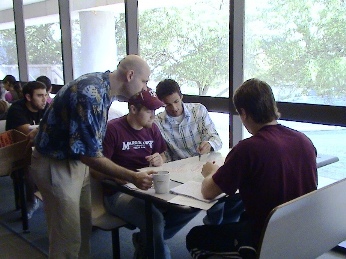
Classes will be very dynamic with a lot of student participation, small
group activities mixed with normal lectures, computer simulations, demonstrations,
etc. To take full advantage of the course come prepared. Read the material
that we are going to cover ahead of time and do not limit yourself to a
single source of reading: become a physicsit and focus on the learning
about the problem from as many sources as possible.
The topics and concepts that we will conver in the course are: |
|
Mathematical Concepts (physics style):
- Complex analysis and multiple representation of oscillations
- Differential equations (1st and 2nd order)
- Fourier analysis and expansion of multi-frequency waves
- Solutions of wave equations and their properties (motion, standing waves, etc.)
- Boundary problems (propagation of waves through changing media)
- Partial differentiation
- Series expansions and geometric series
|
.JPG) |
Physics Concepts Goals:
Thermodynamics and temperature:
- Concept of temperature and thermal equilibrium
- Heat, latent heat (to change phases of matter), mechanisms of heat transfer
- Molar and specific heat capacity
- Definition of a state of a material and the equation of state (thermodynamic variables)
- Idea gas law and PVT diagrams
- Kinetic molecular model of the ideal gas (derivation and link to the experimental law):
- Molecular speeds and collision rates (dependence on thermodynamic variables)
- Heat capacities of ideal gases, diatomic gas, and solids
- First Law of Thermodynamics:
- Relation between heat, work, and internal energy
- Thermodynamic processes: isochoric, isobaric, isothermal, adiabatic
- Heat capacities of a gas (constant P and constant V)
- Engine cycles and efficiency of thermal cycles
- Second Law of Thermodynamics
Oscillatory and periodic motion
- Simple harmonic motion: types, examples
- Single frequency in 1D and 2D, initial conditions
- Oscillation about equilibrium
Waves (sound waves, water waves, E&M, etc)
- Mathematical description of waves: different representations, examples
- Types of waves (transverse, longitudinal) and physical examples
- Speed of waves (mech., sounds, E&M): propagation velocity, phase velocity,
“up down” velocity
- Form of the wave-equation
- Standing and traveling waves
- Multiple frequency waves
- Energy and intensity of waves (log-scale)
- Reflection of waves and boundary conditions in propagation through barriers: reflection and refraction
- Interference of waves (sound, light):
- addition of waves: destructive and constuctive
- beats
- Doppler effect
- Propagation of multi-frequency waves: wave-packet, dispersion, coherence
Connectivity Goals:
- Kinesthetic learning
- 3D geometric visualization of physical phenomena
- Peer interaction problem solving: learn from multiple points of view
- Recognizing equivalent description mathematical description of different physical phenomena
- Relation between phases, velocities, and velocities present in a wave
- Multiple mathematical representations: when, which and why
- Interpreting equations: let the physics be your guide
- How good is your approximation: limits and assumptions in the physical equations
|
Texas A&M University Physics Department
College Station, TX 77843-4242 | (979) 845-7717 | Fax
(979) 845-2590
